How Much Does Office Cleaning Cost
Learn More
Most businesses don’t know what an environmental health improvement notice looks like until they receive one. By that point, the issues behind it have usually been visible internally for months. A bin store nobody wanted to go near. Complaints from staff about the waste area. Pest activity that got managed rather than resolved. Commercial bin cleaning compliance isn’t complicated, but a lot of businesses treat it as someone else’s responsibility until it clearly isn’t.
This article explains what the compliance obligation actually is, what goes wrong when it’s ignored, and how professional commercial bin cleaning keeps you on the right side of it.
UK businesses are legally required to maintain clean premises and to prevent waste from accumulating in ways that create a health risk. For food businesses this extends to active contamination prevention. A neglected bin store sitting adjacent to a kitchen entrance isn’t just unpleasant. It’s a documented compliance failure waiting to be found.
Environmental health officers inspect waste storage areas. They don’t need a complaint to prompt a visit, and when they do visit, a business that can’t show documented maintenance of its bin areas is in a weak position. Improvement notices are the common outcome. Fixed penalty fines follow persistent issues. In serious cases, particularly in food operations, prohibition notices can shut things down while remediation happens. The reputational impact of enforcement action, which is publicly recorded, tends to outlast the operational disruption considerably.
Bin cleaning compliance is not an expensive or complex commitment. It’s a scheduled, documented cleaning programme for waste areas that happens regularly and leaves a paper trail.
What actually happens inside a commercial bin that isn’t being cleaned is straightforward but worth being specific about.
Organic matter decomposes. That decomposition produces bacteria. E. coli, Salmonella, and Listeria are the ones that get mentioned in enforcement notices. They don’t stay inside the bin. They transfer to lids, handles, and the surfaces immediately surrounding the waste area. Staff who handle bins or work near the bin store are in contact with those pathogens regularly, often without knowing it.
Pests follow the food source. An uncleaned commercial bin with accumulated organic residue is a reliable food source. Rats and mice don’t make one visit. They establish routes and they come back. Once that happens, controlling it costs considerably more than the cleaning programme that would have prevented it. Pest control companies will tell you the same thing. The bin store is almost always where it started.
And the smell. This one doesn’t need much explanation. Decomposing organic waste produces persistent odours that carry into car parks, entrances, and outdoor spaces. For customer-facing businesses, this is a daily brand problem that a professional deodorising treatment at each clean resolves.
In practice, any business generating commercial waste should have a cleaning schedule in place. Some sectors face closer scrutiny.
Food businesses are the obvious category. Restaurants, cafes, takeaways, and caterers produce organic waste that decomposes quickly and sits under direct regulatory scrutiny. Care homes and healthcare facilities are audited on hygiene standards regularly. Schools and nurseries carry duty of care obligations that extend to waste areas. Hotels and hospitality venues often have customer-facing spaces very close to their bin stores, which creates a reputation problem as well as a compliance one.
Multi-tenancy buildings present a different version of the same issue. When nobody has clear ownership of the shared bin store, nobody cleans it. A coordinated commercial bin cleaning arrangement solves that.
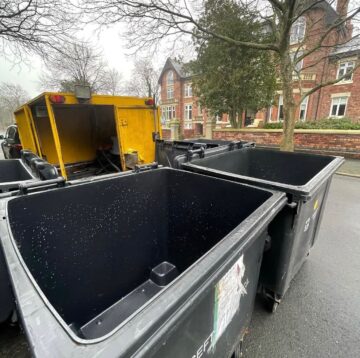
High-pressure interior washing, commercial disinfection, deodorising treatment, and a clean of the bin store itself. That’s what a proper service covers. Not a rinse and a spray. The difference shows in how long the results hold.
The documentation that comes with a scheduled programme is equally important. Dated records of every visit. Evidence that you maintain a proactive approach to waste area hygiene rather than a reactive one. When an environmental health officer asks about your maintenance regime, handing over a documented record is a fundamentally different conversation from trying to explain what you’ve been doing verbally.
Most businesses outsource because the equipment and products needed for commercial-grade bin sanitisation aren’t things a general maintenance team carries. Commercial bin cleaners in Liverpool use specialist high-pressure equipment and industrial disinfectants that deliver results a standard clean can’t match.
The scheduling, documentation, and quality control also shift to the provider. Less operational overhead, proper records, and a clear accountability structure. For most businesses, that’s the more practical arrangement regardless of size.
Priority Cleaning provides professional commercial bin cleaning across Liverpool and Merseyside on schedules tailored to your waste type and volume. We also handle office cleaning and communal cleaning.
Find out more about us, or call 07379 057823 to arrange a site visit. You can also get in touch online.