How Much Does Office Cleaning Cost
Learn More
Most businesses don’t think about health and safety compliance cleaning in relation to their bins. They think about fire risk assessments, manual handling, electrical testing. The bin store doesn’t make the same radar. Until something goes wrong and it turns out to have been the source of the problem.
An environmental health officer doesn’t need much to issue an improvement notice. Documented pest activity, a staff complaint about hygiene conditions, a kitchen inspection that flags the waste area as a contamination risk. The link between commercial bin cleaning and health and safety compliance is direct, and the consequences of ignoring it are real and recoverable but costly.
The legal obligation to maintain clean, safe premises is not ambiguous. Employers are required under health and safety legislation to prevent waste accumulating in ways that create a risk to health. For food businesses, the Food Hygiene Regulations go further: contamination prevention is a specific requirement, not a general aspiration. A row of uncleaned commercial bins next to a kitchen entrance or food delivery point is exactly the kind of thing that triggers enforcement action during an inspection.
Local authorities can issue improvement notices and fixed penalty fines. In more serious cases, hygiene emergency prohibition notices can shut down food operations entirely. The financial cost of a notice is painful. The reputational impact of a publicly recorded enforcement action tends to outlast it considerably.
Health and safety compliance cleaning is not a complex commitment. It’s a scheduled, documented cleaning programme that covers the areas regulations say need to be maintained. Bin stores and waste areas sit clearly within that scope, and businesses that treat them accordingly are in a much stronger position when inspectors visit.
The risks aren’t hypothetical. They’re what happens inside a commercial bin that isn’t being professionally cleaned on a regular schedule.
Food waste and organic matter decompose. That decomposition produces bacteria including E. coli, Salmonella, and Listeria. These don’t stay contained inside the bin. They transfer to lids, handles, and surrounding surfaces, and from there to anyone who interacts with the waste area. In food-handling environments, this is a direct contamination pathway into your operation.
Pests follow food residue. Rats, mice, and flies aren’t attracted to a clean bin. They’re attracted to the accumulated organic material inside one that hasn’t been cleaned. Once pest activity establishes around a bin store, it moves into the wider building. The cost of pest control, by that point, is significantly higher than a regular cleaning schedule would have been.
There are also slip hazards. Leaked waste, grease, and liquid residue around bin store areas create slippery surfaces, particularly in wet weather. Slips and falls are among the most commonly reported workplace injuries in the UK. Bin store access is a known risk point that a cleaning schedule directly addresses.
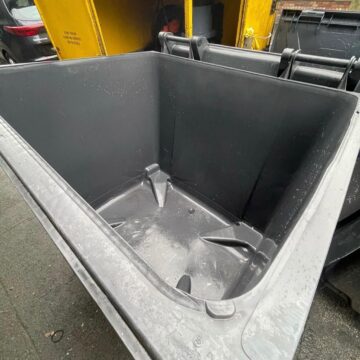
Professional bin cleaning isn’t a surface wipe. It involves high-pressure internal washing to remove the residue causing bacterial growth, commercial-grade sanitisation, deodorising treatment, and cleaning of the surrounding bin store area. That last part matters because walls, floors, and surrounding surfaces accumulate the same material as the bins and create the same risks.
Scheduled health and safety compliance cleaning also generates documentation as a byproduct. Every visit is recorded. That builds a verifiable maintenance history that you can hand to an inspector rather than offer as an explanation. The difference in how those two things land during an inspection is significant.
Any business producing commercial waste benefits from professional bin cleaning, but some sectors face more scrutiny than others.
Restaurants, cafes, and takeaways produce organic food waste that decomposes quickly and creates the highest contamination risk. Care homes and healthcare facilities are audited regularly on hygiene standards. Schools and nurseries carry a specific duty of care obligation. Multi-tenancy commercial buildings often have shared bin stores that nobody has clear responsibility for maintaining.
In all of these settings, scheduled health and safety compliance cleaning is simply part of running the premises properly.
Food businesses should be looking at weekly bin cleaning as a minimum. Offices and retail with lower-risk dry waste can usually manage fortnightly or monthly. The important thing is that the schedule exists, it’s documented, and it’s carried out by someone with the equipment and products to do it properly.
Priority Cleaning provides professional bin cleaning for businesses on schedules that fit your waste type and volume. We also handle communal cleaning and office cleaning if your premises need a broader programme.
Find out more about us, or call 07379 057823 to arrange a site visit. You can also get in touch online.